The language model
A conventional conversational AI interprets the visitor’s question and constructs the words of the spoken or displayed response.

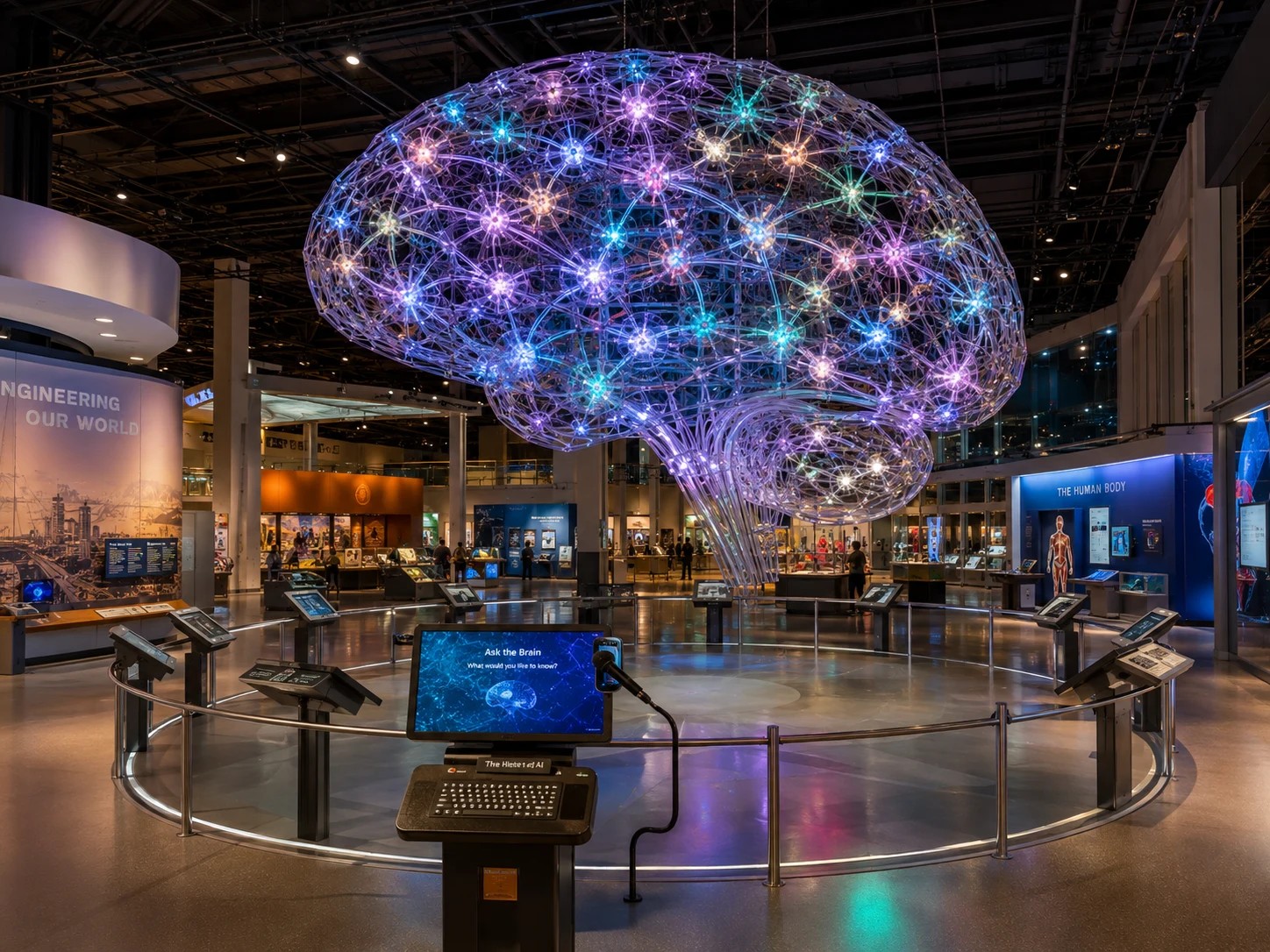
An Analog Cognition Project
A Walk-Through Artificial Brain
Watch intelligence come to life.
A room-scale physical neural computer where visitors can stand beneath analog neurons, watch optical signals travel through the network, and experience normally invisible computation unfolding around them.
Concept rendering. The project is currently in development.
The vision
There are countless ways to interact with artificial intelligence on a screen. The Living Mind is being developed to create something fundamentally different: a place where visitors can stand beneath a brain-shaped network and watch computation unfold through physical state, electrical thresholds, and pulses of light.
The suspended installation will contain dozens of analog artificial neurons. Each neuron will receive signals, accumulate charge, fire after reaching a threshold, and communicate with other neurons through optical pathways. Even at rest, the network will maintain a gentle baseline pattern of activity.
When a visitor asks a question, the entire experience will awaken. Conversational AI will construct the spoken answer while a separate physical neural network receives real signals, evolves according to its own dynamics, and makes its computation visible throughout the exhibit.
What is really computing?
The exhibit will be dramatic, but its scientific credibility depends on showing exactly what each part of the system does.
A conventional conversational AI interprets the visitor’s question and constructs the words of the spoken or displayed response.
Real neuron circuits integrate electrical state, fire at physical thresholds, transmit optical signals, and perform selected temporal, memory, and classification tasks.
Every illuminated neuron and pathway corresponds to a real state or transmitted event. The lighting reveals activity rather than inventing it for decoration.
The suspended brain is not presented as a literal life-size view of every parameter inside a large language model. It is an independent physical neural computer working alongside one.
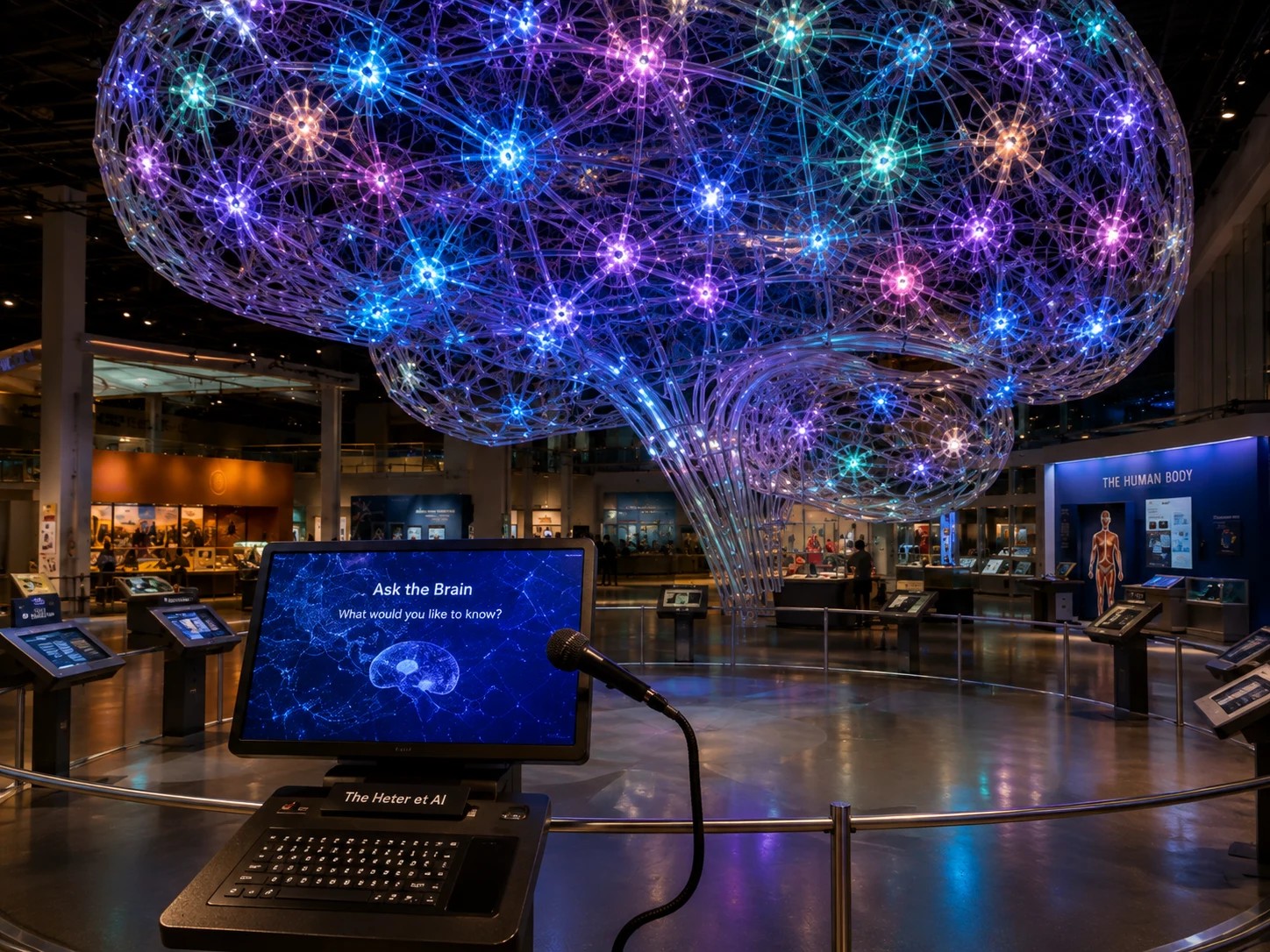 Concept rendering
Central experience
Visitors speak or type a question at the main station. The network begins from a quiet baseline, then visibly moves through listening, interpretation, physical activation, response construction, speech, and a gradual return to rest.
Interactive experiences
Each station is designed around clear physical cause and effect, not just another screen or button-driven animation.
Adjust physical connection weights until a simple learning machine correctly separates patterns into two groups.
Send positive and negative signals into a neuron and watch its physical state rise, fall, and cross the firing threshold.
Place a signal into a recurrent loop and watch the pattern continue after the original input has disappeared.
Control an enlarged transparent neuron and see integration, leakage, threshold, firing, reset, and recovery happen step by step.
Select one physical signal and trace its real journey through neurons, optical pathways, and competing activity.
Replay a recorded firing sequence slowly enough to follow every signal and state change across the network.
Disable a pathway, silence a neuron, or add controlled noise and discover whether the network adapts or loses the pattern.
Reward selected outputs and watch adjustable physical synapses change strength over repeated trials.
Explore how a language model divides text into tokens and uses context to predict what should come next.
Compare an educational view of biological processing with The Living Mind’s live physical response to the same input.
Compete in pattern recognition, reaction time, and prediction challenges that reveal different strengths in people and machines.
Receive an anonymous image or animation of the unique firing pattern created by your interaction.
The Path to Intelligence
A circular timeline surrounds the brain. Visitors can begin anywhere, but the numbered path builds a complete story of artificial intelligence.
1830s to 1936
Charles Babbage, Ada Lovelace, and Alan Turing
Programmable machines began as mechanical designs, then became a universal theory of computation. Before machines could think, people first had to imagine machines that could compute.
1943
Warren McCulloch and Walter Pitts
A simple mathematical neuron combined several inputs and produced an output according to logical rules. The model established the idea that complex behavior could emerge from networks of small units.
1950
Alan Turing
Turing replaced an impossible definition of thought with a practical question about behavior. Could a machine communicate well enough that a person could not reliably distinguish it from a human?
1956
The Dartmouth Workshop
Researchers gave the field a name and explored several paths, including symbolic rules, search, learning systems, and brain-inspired networks.
1957 to 1960
Frank Rosenblatt and the Perceptron
The physical Perceptron learned simple visual patterns by adjusting its own connection strengths. It became a direct ancestor of modern neural networks.
1969 to early 1990s
Early limitations and changing research priorities
Hardware, data, and methods could not yet support the field’s largest ambitions. Neural research slowed while other approaches gained attention, but the core ideas survived.
1982 to 1989
Hopfield, Rumelhart, Hinton, Williams, LeCun, and others
Recurrent networks demonstrated physical memory, while backpropagation made it practical to adjust connections across multiple layers and learn useful internal features.
2006 to 2012
Large datasets, graphics processors, and multilayer networks
Better algorithms, more data, and powerful hardware converged. Deep networks began outperforming older methods in image recognition, speech, and other real-world tasks.
2017 to present
Modern foundation models
Transformers used attention to find relationships across language and other data. They became the foundation for systems that converse, create images, write software, and generate complex content.
Here and now
A physical neural computer
Conversational AI and a separate physical analog network work together. The language model constructs the response while the suspended machine performs real, visible computation of its own.
The future
Physical intelligence beyond conventional computing
Neuromorphic circuits, analog state, optical communication, new materials, and embodied systems may reshape what intelligent machines become and how much energy they require.
Development roadmap
The project advances through testable physical milestones. Each stage must be stable, observable, and maintainable before the next begins.
Prove optical input, analog integration, threshold firing, reset, and visible state.
Demonstrate excitation, inhibition, recurrence, optical propagation, and a simple learned behavior.
Create the first museum-ready lobe with baseline activity, visitor controls, and live instrumentation.
Build the full suspended brain, timeline ring, question station, and complete visitor experience.
Place 20 to 40 Living Mind installations in science museums around the world.
The worldwide vision
Each installation can be adapted to its museum and community while sharing a common physical architecture, educational mission, and global identity. Future locations could exchange small anonymous heartbeat signals and occasionally create synchronized pulses across the entire Living Mind Network.
One day, a visitor might see:
27 Living Minds are awake around the world.
Help build The Living Mind
We are interested in hearing from engineers, researchers, educators, museum teams, fabricators, sponsors, and others who can help turn the concept into a working public installation.
Important questions
That is the goal. The suspended network is being designed around physical analog neuron circuits, adjustable synapses, real state, recurrent activity, and optical communication. The first prototypes must demonstrate these capabilities before the full museum installation is built.
No. A conventional language model provides the conversational layer. The suspended brain is a separate physical neural computer that receives real signals and performs observable computation alongside it.
The name is intentionally poetic. The network will remain active and respond to its environment, but it is not a biological organism. Visible activity demonstrates computation, not consciousness or subjective experience.
Modern AI is usually hidden inside chips, data centers, and software interfaces. The Living Mind makes computation tangible, inspectable, and understandable while also exploring analog and optical approaches to future computing.